
Video as a Brand Asset, not a Campaign
Most brands don’t have a video problem. They have a memory problem.
They create content that works for a moment, then disappears. Campaign ends, relevance fades, and the next video starts from scratch.
A strong video branding strategy changes that. It treats video not as a one-time push, but as a system that builds value over time.
According to Wyzowl’s 2024 report, 91% of businesses use video as a marketing tool, yet many still struggle to extract long-term value from it.
The Real Cost of Campaign-Only Thinking
When video is tied only to campaigns, every project resets the clock.
New script. New style. New tone.
It may perform in the short term, but it rarely compounds.
What This Looks Like in Practice
- A product launch video that feels disconnected from the brand website
- Social clips that don’t match the brand’s voice or visual identity
- Explainers that become outdated within months

Over time, this creates a quiet inefficiency: content that cannot be reused, scaled, or repurposed.
The Content Marketing Institute notes that inefficient content reuse is one of the top causes of wasted marketing budgets.
Short-term video drives attention.
Long-term video builds recognition.
What Makes a Video a Brand Asset?
A brand video is not defined by where it’s used, but by how it’s built.
It is designed to live beyond a single campaign.
Marketing strategist Jenni Romaniuk emphasizes that “brand-building assets must be consistent and distinctive over time to drive mental availability”.
Three Characteristics of Long-Term Brand Assets
- Structural Consistency
The visuals, pacing, and tone follow a defined system, not a one-off idea.
Footage and scenes can be repurposed across channels: website, ads, social, and presentations.
HubSpot reports that repurposing content can increase marketing efficiency by up to 60%.
- Timeless Messaging
Instead of focusing only on “what’s new,” it reinforces what the brand stands for.
If a video cannot be reused, it is not an asset; it is an expense.

Building a Video Branding Strategy That Compounds
A scalable video strategy starts before production.
It begins with clarity.
Step 1 – Define the Role of Video in Your Brand System
Video should not operate in isolation. It must align with:
- Brand voice
- Visual identity
- Messaging hierarchy
Professor Byron Sharp’s research shows that consistent brand assets significantly improve recall and buying probability.
If your website, ads, and videos feel like different companies, the system is broken.
Step 2 – Create Repeatable Formats
Instead of reinventing every video, build formats you can reuse:
- Founder story videos
- Product explainers
- Customer testimonials
- Educational content
These become your content infrastructure, not just outputs.
Step 3 – Design for Multi-Channel Use
Every video should be planned for:
- Full-length version (website, YouTube)
- Short-form cuts (social media)
- Snippets (ads, presentations)
This is where cost efficiency begins.

A study by Vidyard found that businesses using multi-format video strategies see higher engagement and retention across channels.
The most valuable videos are not the most creative; they are the most reusable.
Why Most Brand Videos Don’t Age Well
Many teams say, “Our videos feel outdated too quickly.”
This is rarely a production issue. It is a strategy issue.
The Common Failure Points
Trend-Driven Styling
Overuse of current trends (effects, transitions, memes) that expire quickly.
Campaign-Specific Messaging
Videos tied too closely to time-sensitive offers or events.
Lack of Brand Anchors
No consistent visual or narrative elements to tie the content together.
The Ehrenberg-Bass Institute highlights that distinctive brand assets, not trends, drive long-term brand growth.
The Alternative Approach
Shift from “What are we promoting?” to:
“What should people remember about us over time?”
That shift alone changes how scripts are written, how visuals are chosen, and how content is structured.
The Business Case for Long-Term Video Assets
This is not just a creative decision. It is a financial one.
1. Reduced Production Costs Over Time
Reusable footage and formats reduce the need for constant new shoots.
A good case study is how Salesforce built a centralized video content library, enabling teams to reuse footage across campaigns, significantly reducing production costs and turnaround time.
2. Faster Content Turnaround
With a system in place, new content becomes adaptation, not reinvention.
3. Stronger Brand Recall
Consistency builds familiarity. Familiarity builds trust.
Nielsen research shows that consistent branding across channels can increase revenue by up to 23%.
4. Scalable Content Ecosystem
One well-produced video can generate:
- 5–10 social clips
- Website sections
- Ad creatives
- Sales materials
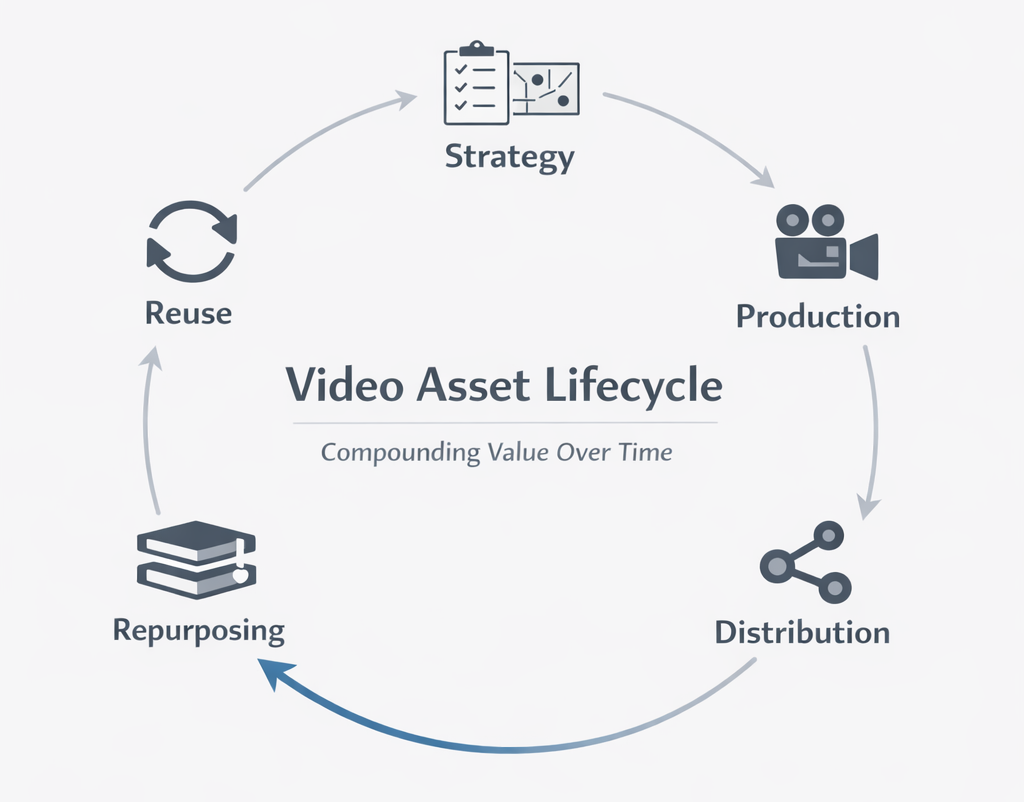
A popular case study is how Nike frequently repurposes campaign footage into evergreen brand storytelling content, reinforcing identity across platforms rather than creating isolated pieces.
A single video can either cost you once or pay you repeatedly.
How to Transition from Campaign Content to Brand Assets
This shift does not require a full reset. It requires a change in approach.
Start With Your Next Video
Before production, ask:
- Can this be reused in 6–12 months?
- Can it be broken into multiple formats?
- Does it reinforce our core brand message?
If the answer is no, adjust before filming.
Build a Video Library
Treat your footage like a strategic resource:
- Organize clips by theme and use case
- Store raw footage for future edits
- Tag content for easy retrieval
Over time, this becomes your brand asset bank.
Align Teams Around the System
Marketing, content, and design teams should work from the same video framework.
This is where many strategies fail, not in execution, but in alignment.
Frequently Asked Questions
- What is a video branding strategy?
A video branding strategy defines how video content consistently communicates your brand across channels while remaining reusable and scalable over time.
- How is a brand video different from a campaign video?
A brand video is designed for long-term use and consistency, while a campaign video is typically tied to a specific promotion or timeframe.
- Can small businesses build long-term video assets?
Yes. Even with limited budgets, focusing on reusable formats and consistent messaging creates compounding value over time.
- How many videos should a brand create?
It’s less about volume and more about structure. A few well-designed videos can produce dozens of usable assets.
- What’s the biggest mistake in video marketing?
Treating every video as a standalone project instead of part of a larger brand system.
Let That Sink In
If your videos feel disconnected, short-lived, or hard to reuse, the issue isn’t effort; it’s structure.
At Adessi, we design video systems that scale with your brand, so every piece of content works harder, longer, and more consistently.